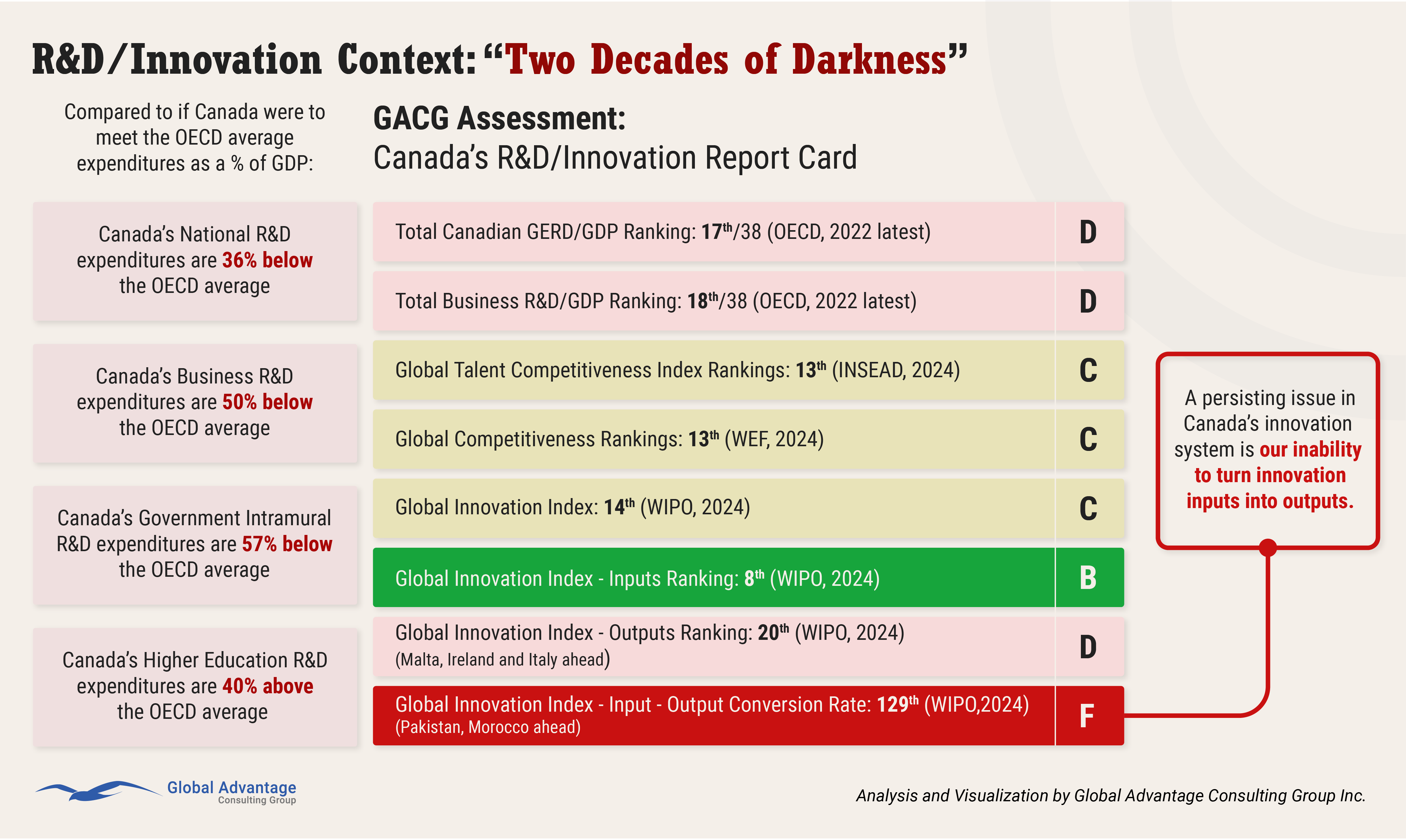
Canada has the talent, resources, and potential to be a global innovation leader. Yet, it ranks 14th in the Global Innovation Index (WIPO, 2024) – 8th in innovation inputs and 20th in outputs – falling well behind other advanced economies. This disconnect between potential and performance demands urgent action to transform Canada’s innovation ecosystem for global competitiveness.
A healthy innovation ecosystem relies on collective stakeholder understanding, tracking, strategizing, and acting on dozens of key factors and indicators. This article focuses on several of these factors and indicators with an aim to continue to spur a healthy conversation. The Canadian government is in the process of forming a new advisory Council on Science and Innovation, comprised of leaders from the academic, industry, and not-for-profit sectors, that will be responsible for developing a new national science and innovation strategy for the country, according to Budget 2024.
Innovation performance in Canada has long been a significant concern and a topic of debate in policy and public circles. There is general consensus that Canada must address the problem of poor performance in turning its research and technology into commercialized innovations. However insufficient, while the country invests in innovation in the form of research and development (R&D), education, infrastructure, and strong institutions supplying support for innovative activities; translation of these into innovation outputs (application, exploitation, and impact) is not happening consistently and at scale. Innovation performance is closely tied to competitiveness and economic productivity, which is at a state of “emergency”, as stated by the Senior Deputy Governor Carolyn Rogers in March 2024. In turn, productivity and competitiveness lead to faster growth, more jobs and higher wages, and ensures Canada’s ability to sustain public investments in social, health, and environmental priorities–all critical to the well-being of its citizens.
The R&D and Innovation Investment Gap: Addressing Canada’s Low Spending
R&D activities are a fundamental component of innovation. In 2022, Canada accounted for about only 1.3% of global R&D investments. On the other hand, the US and China combined accounted for 55%. Canada has challenges in accessing new global knowledge systematically and the need for a more effective innovation strategy. Furthermore, Canada’s national R&D expenditures in 2022 were 37% below the average of Organization for Economic Cooperation and Development (OECD) countries as a percentage of Gross Domestic Product (GDP), resulting in a $28.7 billion annual investment gap, according to Global Advantage Consulting Group’s analysis. Although Canada’s higher education R&D expenditures as a percentage of GDP are 40% above the OECD average, Canada’s business R&D expenditures are 50% and government intramural R&D expenditures are 57% below the OECD average.

While OECD comparisons of various R&D metrics are key, they are not the only one. Canada also lacks in recent investments in machinery and equipment (which indicates embedded innovation) as well as investments in intangibles including intellectual property. There are such key issues in Canada’s innovation system as low investment, lack of competitive strategies and implementation, and poor coordination. Regulatory burden is major barrier to innovation. According to Senator Colin Deacon’s February 2023 report, “Stagnant regulations impair innovation and economic growth”, Canada ranks 35th out of 38 OECD countries in Regulatory Burden. At the same time, Europe is launching a “simplification revolution” and the new US President Donal Trump is expected to “deregulate” the US economy. Modernizing Canada’s regulatory and procurement systems is critical to fostering innovation. Our overall assessment of Canada’s R&D/Innovation, through a detailed report card, incorporates a series of reputable Indexes to position Canada’s performance, such as the Global Competitiveness, Global Talent Competitiveness, Global Innovation Index, and others.
Retaining and Scaling Canadian Companies
Ownership and control of promising innovative companies are fundamental to improving Canada’s innovation ecosystem. Retaining homegrown companies and providing the necessary tools and support mechanisms to scale up within Canada must be a top priority (see for instance A Blueprint for the Canada Innovation Corporation, 2023 and Building a Nation of Innovators, 2019). It is about creating a policy environment that encourages firms to stay in Canada and thrive within the global economy.
In the context of scaling up, one of the most frequently cited factors is the critical role of financial capital. Many Canadian companies relocate their headquarters to the U.S. due to greater availability and ease of access to capital. There are dozens of instances but for one, Encana Corp., one of Canada’s oldest energy companies, moved its headquarters from Calgary to the U.S. in 2019, citing better access to investment as a key reason. While some argue that Canada may never match U.S. investment levels, innovative financial and new partnership models must be explored to address this challenge. For instance, to what extent are Canada’s pension funds investing in Canadian companies to support this effort? In March 2024, more than 90 top Canadian business leaders have signed an open letter to the Federal Minister of Finance and Provincial Ministers of Finance, urging the need to address the decline in domestic investments by pension funds. The letter noted that Canadian pension funds have reduced their holdings of publicly traded Canadian companies from 28% of total assets in 2000 to less than 4% at the end of 2023.
Additionally, the U.S.’s recent protectionist and competitive policies, measures, and incentives have created a push-and-pull dynamic influencing Canadian companies’ decisions to stay or relocate. Policies such as the Tax Cuts and Jobs Act of 2017, the Inflation Reduction Act, and the CHIPS and Science Act of 2022 have enhanced the attractiveness of the U.S. as a destination for business operations. These kinds of measures aimed at bolstering domestic competitiveness and innovation are expected to continue to roll out of the U.S. system under the new presidency, posing challenges for Canada in retaining and growing its firms. They highlight the need for a strategic response to ensure Canadian businesses remain innovative, productive, and competitive in a rapidly evolving North American and global market.
The Talent Shortage: Closing the Skills Gap
A significant challenge in Canada’s innovation ecosystem is the availability of talent that aligns with the needs of its industrial sectors and service economy. Despite having one of the world’s most educated workforces, leading the Group of Seven (G7) with 57.5% of Canadians aged 25 to 64 holding a college or university degree, there remains a notable shortage of skilled professionals in key areas. To address these gaps, Canada must continue developing relevant skills domestically and scaling upskilling and reskilling programs to match the growing pool of companies.
About 2/3 of Researchers end up working in the Private Sector; therefore, transferring Higher Education talent and skills, with the research knowledge and skills they’ve acquired, to industry becomes even more paramount. Beyond talent development is the importance of enhancing Industry-Academia Collaboration to ensure knowledge update and use to meet the citizens’ needs. The number one challenge Canadian companies face is acquiring talent. If the domestic market cannot produce the necessary skills and competencies promptly and at scale, it is natural to look globally to attract and retain essential talent. ISED highlights the reliance on international talent to fill some of these roles. Leveraging the remote working environment that has become a significant part of the new normal.
Conclusion: Transforming Canada’s Innovation Ecosystem for Global Competitiveness
Canada needs an increased focus on demand-side measures to balance overreliance on the supply side to improve its Innovation performance, such as the regulatory and procurement systems’ modernization and derisking the adoption and diffusion of innovations across the Canadian industry and business landscape.
Canada should integrate the existing elements of siloed industrial strategies, plans, roadmaps, metrics, and processes, while developing complementary and globally competitive new ones to improve performance. For Canada’s innovation ecosystem to thrive, it must operate with a global mindset and vision. This requires identifying and targeting problems and gaps in domestic and international markets to address with new and innovative products, services, processes, and business models.
In the current global context, Canada must take a closer look at economic security and supply chain resiliency. Innovation must be a Whole of Government priority, aligning all levers, spending; tax; regulations; procurement; and trade programs. It’s long overdue for Canada to rethink its innovation policies and integrate its programs aimed at addressing “The Great Fragmentation” (which currently encompasses over 130 programs supporting business innovation and growth, at the federal level alone).
Canada should set a national R&D/GDP target, as most industrialized nations have done (e.g., Finland, the EU, the UK, and China). Budapest Declaration on the New European Competitiveness Deal reiterated Europe’s objective of meeting the 3% GDP expenditure target on R&D by 2030.
Canada must urgently address the disconnect between its innovation potential and performance by closing the R&D and innovation investment gap, retaining and scaling Canadian companies, addressing talent and skills shortage, and adopting a global market mindset to transform its innovation ecosystem into a competitive leader.