On December 16th, the Canadian government released its 2024 Fall Economic Statement, outlining its fiscal strategy and proposed investment priorities. Following Prime Minister Justin Trudeau’s resignation and the anticipation of a new U.S. administration, political uncertainty casts doubt on the future implementation of these initiatives. Nevertheless, this statement provides a glimpse into the government’s proposed direction, offering a foundation for reflection and consideration by the incoming leadership. In this blog post, we explore the statement’s key highlights, focusing on the potential impacts and implications across various sectors.
Fiscal Outlook: A Growing Deficit
The projected deficit for the fiscal year 2023-2024 had climbed to $61.9 billion, exceeding the initial target of $40.1 billion set in the previous year. This widening gap underscored the challenges facing the Canadian economy and the government’s efforts to balance fiscal responsibility with targeted investments.
Investment Priorities: Clean Growth, Innovation, and Affordability
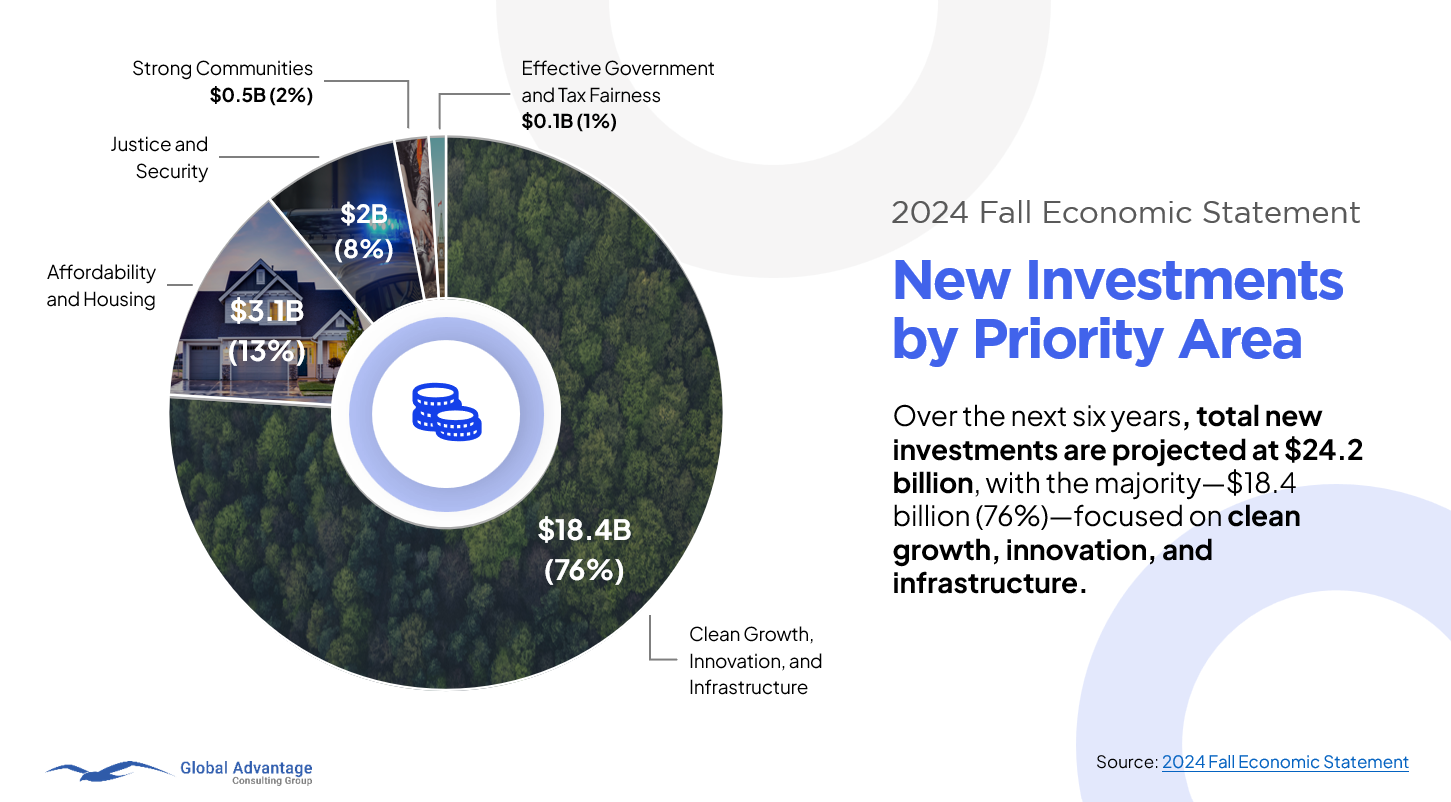
The statement proposed $24.2 billion in new investments over the next six years, with the majority (76% or $18.4 billion) allocated to clean growth, innovation, and infrastructure projects. Affordability and housing initiatives received the second-largest share at $3.1 billion (13%). Notably, the top five investments included:
- $17.4 billion to extend the Accelerated Investment Incentive, encouraging business investments.
- $1.6 billion for a “Tax Break for All Canadians” (details not specified).
- $1.3 billion to enhance border security measures.
- $1.1 billion to bolster the Scientific Research and Experimental Development (SR&ED) Tax Credit, promoting research and development activities.
- $598 million to remove prohibited firearms and compensate owners of assault-style firearms.

Sector-Specific Implications
The Fall Economic Statement had wide-ranging implications across various sectors. Here’s a breakdown of the potential impacts:
Research and Innovation:
- The SR&ED tax incentive program received a significant boost, with an increased expenditure limit for the refundable tax credit and eligibility expansion to include certain public corporations.
- A new Canadian Sovereign AI Compute Strategy was launched, aiming to support researchers and AI firms with up to $500 million over four years.
- Additional funding was directed towards Global Innovation Clusters and National AI Institutes to support AI commercialization.
- However, no new direct investments were announced for life sciences, biomanufacturing, or related fields, although indirect benefits may have arisen from broader policies like the SR&ED enhancements and patent box measures.
Defence and Security:
- A $1.3 billion comprehensive border security package was allocated to strengthen border control and security agencies.
- The government proposed amendments to the Export and Import Permits Act to restrict imports and exports in response to actions by other countries that could harm Canada or disrupt supply chains.
- Domestic content requirements for federally funded infrastructure projects were being explored to prioritize Canadian businesses and innovators.
Clean Energy:
- Substantial investments targeted nuclear energy, including support for research and environmental initiatives, enriched nuclear fuel contracts, and administration of the enriched nuclear fuel program.
- The Clean Electricity Investment Tax Credit (ITC) offered a 15% refundable tax credit for clean electricity property, with eligibility extended to Crown corporations under certain conditions.
- Expansion of the Clean Hydrogen ITC included methane pyrolysis as an eligible hydrogen production pathway.
- The Electric Vehicle (EV) Supply-Chain Tax Credit provided a 10% refundable tax credit to support investments in EV assembly, battery production, and related areas.
Natural Resources:
- The statement highlighted the importance of natural resource exports and their regulation, both domestically and internationally.
- Funding was allocated to the Canadian Food Inspection Agency to support agricultural trade expansion.
- Tariffs on imports of solar products and critical minerals from China were planned for early 2025, with additional tariffs on semiconductors and other materials beginning in 2026, aiming to address unfair trade practices.
Regulations, Procurement, and Talent:
- Proposed regulatory measures addressed election security, red tape reduction, and climate and corporate governance, including amendments to the Canada Business Corporations Act to mandate climate-related financial disclosures for large private corporations.
- Strict enforcement of federal procurement trade obligations was planned from spring 2025, prioritizing access for Canadian businesses and reciprocal trade partners.
- Talent development initiatives included funding for Shad Canada to expand STEM programming, a pilot initiative focused on key sectors like biomanufacturing and clean growth, and exploration of a framework to facilitate health care worker mobility across Canada.
Non-Profit and Networked Organizations:
- New reporting requirements aimed to increase transparency and accountability within the non-profit sector.
- NPOs with gross revenues over CA$50,000 were required to file annual information returns, while smaller NPOs would file simplified returns.
- These measures were expected to enhance accountability but may also have increased administrative burdens for some organizations.
Universities, Colleges, and Institutes:
- Increased funding for Shad Canada expanded STEM programming and mentorship opportunities for high school students, potentially boosting enrolment and diversity in post-secondary STEM fields.
- Credential recognition measures aimed to improve the integration of newcomers and interprovincial movers into the workforce, including potential tax penalties for regulatory colleges that hinder credential recognition.
- These initiatives could have led to enrolment growth, better labour market alignment, and increased accountability for institutions.
Businesses and the Private Sector:
- The capital gains rollover for Eligible Small Business Corporation (ESBC) shares was expanded, with preferred shares now qualifying and an increased asset threshold for ESBC status.
- Support for SME digital technology adoption was provided through funding to the Business Development Bank of Canada, prioritizing AI adoption.
- These measures aimed to increase investment capital availability, boost business growth, and provide greater flexibility for entrepreneurs.
Governments:
- The government planned to legislate the role and mandate of the Chief Science Advisor and establish a new Red Tape Reduction Office.
- A small business innovation program was proposed to support federal departments and agencies in meeting new procurement targets and fostering collaboration with small businesses.
Overall, the 2024 Fall Economic Statement signals the Canadian government’s commitment to addressing key economic, social, and environmental challenges while attempting to make strategic investments in clean growth, innovation, and affordability. The wide-ranging implications for various sectors reflect its potential to shape Canada’s economic landscape, though much depends on how these initiatives will be carried out under new leadership. As the political landscape shifts, it will be crucial to monitor how these proposed investments and changes evolve.